
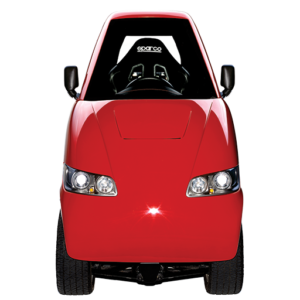
The story
Commuter Cars was founded in Spokane, Washington, by Rick Woodbury and his son Bryan Woodbury in 1998. Bryan Woodbury says that his father had come up with the original idea sometime in the early 1980s. He had learned that 106 million people in the United States were driving to work alone. He came up with the idea for a single-seat electric car. In the 1980s, Woodbury began researching hydrogen power, which led to fuel cells. The relatively lightweight nature of the fuel cells led to his idea of a stable, narrow vehicle with a low center of gravity. While waiting for fuel cell technology to catch up, he eventually settled on a design for the car to have individual electric motors for each wheel. In his spare time, he worked on building his first car. In 1998, he sold his yacht to fund the company. He settled on a plan to use parts that were already produced, instead of producing every part for the vehicles. Commuter Cars used various parts manufactured for other, more common cars. Among those parts was a safety cage made to NASCAR specifications.
Production of the first of their line of ultra-narrow electric sports cars began with the Tango T600. The company designed a small electric car. They stated that production of the first version, at a rate of about 100 cars per year, was set to begin in late 2005. Actor George Clooney took delivery of the first Tango kit on August 9, 2005, which was a major milestone for the company. Clooney appeared in the press with the car, explaining its features and promoting it. Difficulties with their UK manufacturer forced Commuter Cars to take over manufacturing themselves; for this reason, the second vehicle did not ship until February 11, 2008. It was completely assembled in Spokane, Washington. The second car eventually found its way into the second-floor office of Google CEO Eric Schmidt as part of an April Fools' Day joke.
By 2008, Commuter Cars had produced only 10 cars, each selling for an average of $121,000. The company generated a significant amount of media interest with the sale to Clooney. However, that initial media attention did not lead to a production deal.
In 2010, the company entered the Progressive Insurance Automotive X Prize in the "Alternative" category. The vehicle entered was a Tango T600 owned by Google founder Sergey Brin, borrowed back for the competition. After passing many of the performance tests with ease, the car failed to complete the 100-mile durability run (one of the more complex requirements for the prize) and was eliminated from the competition. The company did not get a production deal with a manufacturer, and by 2014, fewer than 20 cars had been built in the United States.
Throughout the company's history, Commuter Cars has had limited financial resources. Whenever the company did generate a profit, it reinvested the money in research and production capacity for its future vehicles. When the company had sufficient funding during 2007, it employed eight workers and was able to manufacture one car each month.
By 2018, Car and Driver magazine gave the company a 1.1 out of 10 chance of survival.
From Wikipedia’s article on Commuter Cars, shared under CC BY-SA 4.0.4