


The story
Early history
Around 1830, Antoine "Toone" Genty (1804–1890) opened his poechenellenkelder (lit. 'puppet cellar'), a traditional theatre of marionettes in the Marolles/Marollen district of Brussels. The origin of Brussels' puppetry stems three centuries earlier from an order issued by Philip II of Spain, son of Charles V, who, hated by the population, had the city's theatres closed to prevent them from becoming gathering places likely to encourage hostility towards the Spanish authorities. The people of Brussels had then replaced the actors with poechenelles (puppets) in underground theatres.
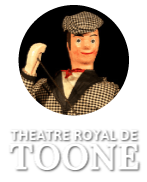
At the start of the 19th century, puppet theatres were one of the most successful forms of entertainment for adults in Brussels' working class neighbourhoods. They allowed for great freedom of tone, using a varied repertoire borrowed from popular legends, tales of chivalry, operas, and even religious or historical pieces, broken down into acts and interpreted very freely. They were also a means of popular education. Indeed, illiterate people could not afford the opera or the big theatres. The puppet shows thus allowed them to keep abreast of cultural events. This popular form of entertainment still exists and has evolved today into the Royal Theatre Toone.
20th century
Since the 1930s, renowned Belgian artists, writers and patrons have taken part in the defence of this heritage, among them the avant-garde dramatist Michel de Ghelderode (1898–1962), who also wrote plays for the theatre. Later on, some of his other works were adapted to theatre plays by the current owners: José Géal (also known as Toone VII), and his son Nicolas (also known as Toone VIII). Other personalities who supported the theatre and its creations in their lifetimes include the sculptor and jeweller Marcel Wolfers (1886–1976), as well as the painters Jef Bourgeois (1896–1986) and Serge Creuz (1924–1996).
The Royal Theatre Toone was relocated in 1963 by José Géal (or Toone VII) to its current premises, a building dating from 1696 on the Rue du Marché aux Herbes/Grasmarkt, near the Grand-Place/Grote Markt in central Brussels. The building that now houses the theatre and the alleyway where it is located were designated as a protected ensemble on 27 February 1997.
21st century
Until 2018, the permanent museum of Toone was located on the first floor of the main building, and could be visited free of charge during performance times. As part of extension works, three houses adjacent to the historic building were acquired and fully renovated thanks to a contribution of €1.3 million from Beliris. The main goal of these works, which lasted two years, was to improve accessibility and comfort for visitors, artists and suppliers, as well as to allow access to the museum outside performance times.
In 2018, the Royal Theatre Toone was included in the inventory of intangible cultural heritage of the Brussels-Capital Region. An application is ongoing to recognise the theatre's marionettes as a Masterpiece of the Oral and Intangible Heritage of Humanity by UNESCO, a distinction already held by other notable puppeteers of popular tradition. On 11 April 2024, Toone received the European Heritage Label in recognition of its cultural and historical significance. On 9 December 2025, Brussels' rod marionette tradition was inscribed on the Representative List of the Intangible Cultural Heritage of Humanity.
From Wikipedia’s article on Royal Theatre Toone, shared under CC BY-SA 4.0.4