
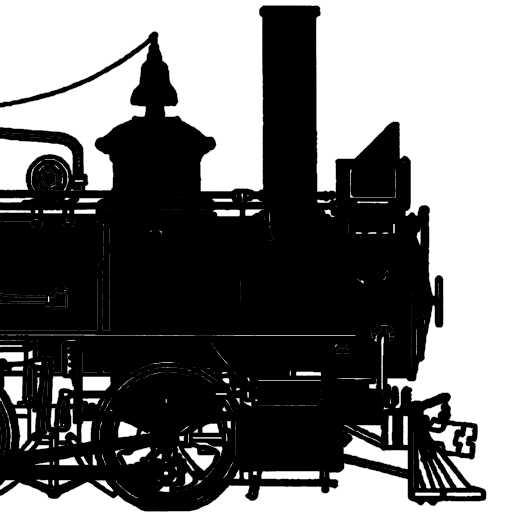


The story
History
The line began operating to Weeks Mills on February 20, 1895, as the Wiscasset and Quebec Railroad. The line was reorganized in 1901 as the Wiscasset, Waterville and Farmington Railway following the inability to negotiate a crossing of the Belfast and Moosehead Lake Railroad near Burnham Junction. The reorganized WW&F completed a branch line from Weeks Mills to the Kennebec River at Winslow but failed to negotiate a connection with the Sandy River Railroad at Farmington, and therefore never reached Quebec.
The WW&F hauled potatoes, lumber, and poultry along with other general freight and passengers. Freight tonnage in 1914 was 43% outbound lumber, 16% outbound potatoes and canned corn, 14% inbound feed and grain, 10% inbound manufactured goods, 5% inbound coal, and 4% outbound hay.
In the late 1920s, the railroad began to struggle, thanks to competition from roads. It was purchased by Frank Winter, a businessman with lumber interests in Palermo. He had also bought two cargo schooners, which he proposed would carry coal north from Boston and return south with lumber, while the railroad would transport coal and lumber between Wiscasset and interior points in Maine. On June 15, 1933, as a result of a locomotive derailment, operations ceased and this business venture never came to fruition. Winter died in 1936. Most of the railroad was scrapped, while the schooners were abandoned beside the railroad wharf in Wiscasset.
Wiscasset, Waterville & Farmington Railway Museum
Beginning in 1989, a non-profit organization established the WW&F Railway Museum, which continues to operate as of 2026. It restored several privately owned pieces of former WW&F rolling stock and has rebuilt 3.5 miles of former WW&F track in Alna. The museum runs 2 ft (610 mm) gauge steam and diesel locomotives and other historic equipment, and has other pieces on static display.
Main Line geography 1895–1933
Milepost 0: Wiscasset -
Transfer yard largely built on pilings over the Sheepscot River estuary including a wharf, passing siding, interchange tracks with the standard gauge Maine Central Railroad and spurs serving a creamery and a grain warehouse.
North of the transfer yard was the diamond crossing of the Maine Central Railroad with a wooden platform connecting separate station buildings for the two railroads.
A 3-stall enginehouse and turntable, a long coal shed, a large 3-track car shop, two storage sidings, and a water tank were north of the Maine Central diamond.
Read the full text
Milepost 4.8: Sheepscot -
Small agent's station building with a northbound spur.
Milepost 6.4: Alna Centre -
Small flag stop passenger shelter.
"Top of Mountain" was a southbound spur atop the uphill grade from Head Tide to Alna
Milepost 9.1: Head Tide -
Agent's station building of standard design with 2 southbound spurs. Some distance north of the station a third southbound spur served a gravel pit. A covered water tank was north of the gravel pit.
Milepost 12.3: "Iron Bridge"
The most impressive bridge on the line carried the rails over the Sheepscot River. The railroad was within a relatively steeply incised portion of the Sheepscot River valley between Head Tide and Whitefield. The through truss bridge had previously been used as part of an early Maine Central Railroad bridge over the Kennebec River at Waterville, Maine.
Milepost 13.3: Whitefield -
Agent's station building of standard design with a passing siding.
Milepost 15.7: Prebles -
Small flag stop passenger shelter.
Milepost 17.4: North Whitefield -
Agent's station building of standard design with a southbound spur serving a potato warehouse. A short distance north of the station, a second southbound spur served Clary's mill.
Milepost 20.4: Cooper's Mills -
Agent's station with a passing siding and a southbound spur serving a potato warehouse. The original station was a covered design with doors at either end to allow the train to pass through; but this was replaced in the early 1900s with a newer design similar to those constructed on the Winslow branch. There was a covered water tank south of the station.
Milepost 23: Maxcy's -
Small flag stop passenger shelter with a southbound spur.
Milepost 24: Windsor -
Agent's station building of standard design with a southbound spur.
Milepost 28.2: Weeks Mills -
Agent's station building of standard design with a separate shed-roofed freight house, a covered water tank, one or two passing sidings, a wye for the branch to Winslow, and two southbound spurs for a potato warehouse and a cannery.
Milepost 31: Newell's -
Small flag stop passenger shelter with a southbound spur.
Milepost 32.9: Palermo -
Agent's station building of standard design with a passing siding and a southbound spur serving a potato warehouse. Some distance north of Palermo was a covered water tank, a southbound spur serving a gravel pit, and, in later years, a northbound spur serving a sawmill owned by the last operator of the railroad.
Milepost 36.5: Cole's -
Flag stop.
Milepost 38: China -
Agent's station building of standard design with a southbound spur serving a potato warehouse.
Milepost 40: South Albion -
Small flag stop passenger shelter.
Milepost 43.5: Albion -
Agent's station building of standard design was subsequently modified to add a second story with living quarters. Several southbound spurs served a cannery, a sawmill, a tannery, and two potato warehouses. A turntable and single-stall enginehouse were near the station, and there was a covered water tank about a half-mile south of the station.
Branch Line geography 1902–1916
Milepost 31.5: South China - Agent's station building of newer design with a northbound spur serving a potato warehouse. There was a covered water tank about one-quarter mile south of the station.
Milepost 32.5: China Lake - Flag stop.
Milepost 33.7: Clark's - Flag stop.
Milepost 36.5: East Vassalboro - Agent's station building of newer design with a northbound spur.
Milepost 39.1: North Vassalboro - Agent's station building of newer design with a southbound spur. A northbound spur served a gravel pit south of the station. Three southbound spurs served an American Woolen Company mill north of the station; and there was a covered water tank north of the woolen mill.
Milepost 42.7: Winslow - Agent's station building of newer design with a southbound spur. There was also a turntable and enginehouse for the decade this point served as the primary northern terminus of the railroad. Rails were removed from the Winslow end of the branch in 1912, but the railroad provided freight service as far as North Vassalboro for a few more years.
From Wikipedia’s article on Wiscasset, Waterville and Farmington Railway, shared under CC BY-SA 4.0.4