

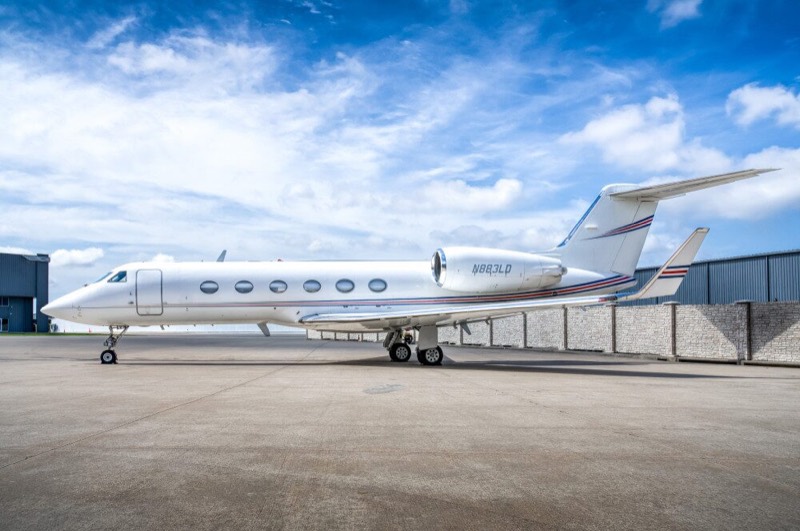
Plane · No signal
Gulfstream IV SP17
Last reported Jul 7, 2026 at 19:15 UTC.
Ownership reported in the press, not confirmed from a registry.

American boxer and boxing promoter (born 1977)
Floyd Joy Mayweather Jr. (né Sinclair; born February 24, 1977) is an American professional boxer and boxing promoter.2
From Wikipedia’s article on Floyd Mayweather (this version), CC BY-SA 4.0.
Born Feb 24, 1977.1
He is undefeated at 50–0. Mayweather won 15 major world championships spanning five weight classes from super featherweight to light middleweight. This includes the Ring magazine title in three weight classes. As an amateur, he won a bronze medal in the featherweight division at the 1996 Olympics, three U.S. Golden Gloves championships (at light flyweight, flyweight, and featherweight), and the U.S. national championship at featherweight. After retiring from professional boxing in August 2017, he transitioned to exhibition boxing.
As of July 2025, BoxRec ranks him the third greatest boxer of all time, pound for pound. Mayweather was named "Fighter of the Decade" for the 2010s by the Boxing Writers Association of America (BWAA) and The Sporting News, a two-time winner of The Ring magazine's Fighter of the Year award (1998 and 2007), a three-time winner of the BWAA Fighter of the Year award (2007, 2013, and 2015), and a six-time winner of the Best Fighter ESPY Award (2007–2010, 2012–2014). In 2016, ESPN ranked him the greatest boxer, pound for pound, of the last 25 years; in 2024, they also ranked him the best boxer of the 21st century. In 2025, The Ring ranked him the greatest boxer, pound-for-pound, of the 21st century.
He is referred to as one of the best defensive boxers in history: since the existence of CompuBox, Mayweather is the most accurate puncher among professional boxers, having the highest plus–minus ratio in recorded boxing history. He has a tied record with Joe Louis of 26 consecutive wins in world title fights. He also holds 24 wins (7 KOs) against former or current world titlists, and 8 wins (3 KOs) against International Boxing Hall of Fame inductees. He was inducted into the International Boxing Hall of Fame in the class of 2021.
Mayweather is one of the most lucrative pay-per-view attractions of all time, in any sport. He topped the Forbes and Sports Illustrated lists of the 50 highest-paid athletes of 2012 and 2013, and the Forbes list again in both 2014 and 2015, as the highest-paid athlete in the world. In 2006, he founded his own boxing promotional firm, Mayweather Promotions, after leaving Bob Arum's Top Rank. He has generated approximately 24 million PPV buys and $1.67 billion in revenue throughout his career. In 2018, he was the highest-paid athlete in the world, with total earnings, including endorsements, of $285 million, according to Forbes. In November, 2021, Mayweather was ranked by Sportico as the sixth highest-paid athlete of all time, with his income totaling an inflation-adjusted $1.2 billion; he stood at No. 10 when the ranking was updated in April, 2026, with his earnings estimated at inflation-adjusted $1.57 billion.
From Wikipedia’s article on Floyd Mayweather, shared under CC BY-SA 4.0.2
Mayweather was born Floyd Joy Sinclair on February 24, 1977, in Grand Rapids, Michigan, into a family of boxers. His father, Floyd Mayweather Sr., is a former welterweight contender who fought Hall of Famer Sugar Ray Leonard. His uncles Jeff and the late Roger Mayweather were professional boxers, with the latter—Floyd's former trainer—winning two world championships, as well as fighting Hall of Famers Julio César Chávez, Pernell Whitaker, and Kostya Tszyu. Mayweather was born with his mother's last name, but his last name would change to Mayweather shortly thereafter. His maternal grandfather was born in Kingston, Jamaica. He attended Ottawa Hills High School before dropping out.
Boxing has been a part of Mayweather's life since his childhood and he never seriously considered any other profession. "I think my grandmother saw my potential first," he said. "When I was young, I told her, 'I think I should get a job.' She said, 'No, just keep boxing.'" During the 1980s, Mayweather lived in the Hiram Square neighborhood of New Brunswick, New Jersey, where his mother had relatives. He later said, "When I was about eight or nine, I lived in New Jersey with my mother and we were seven deep in one bedroom and sometimes we didn't have electricity. When people see what I have now, they have no idea of where I came from and how I didn't have anything growing up."
It was common for the young Mayweather to come home from school and find used heroin needles in his front yard. His mother was addicted to drugs, and he had an aunt who died from AIDS because of her drug use. "People don't know the hell I've been through," he says. The most time that his father spent with him was taking him to the gym to train and work on his boxing, according to Mayweather. "I don't remember him ever taking me anywhere or doing anything that a father would do with a son, going to the park or to the movies or to get ice cream," he says. "I always thought that he liked his daughter [Floyd's older sister] better than he liked me because she never got whippings and I got whippings all the time."
Mayweather's father contends that Floyd is not telling the truth about their early relationship. "Even though his daddy did sell drugs, I didn't deprive my son," the elder Mayweather says. "The drugs I sold, he was a part of it. He had plenty of food. He had the best clothes and I gave him money. He didn't want for anything. Anybody in Grand Rapids can tell you that I took care of my kids". Floyd Sr. says he did all of his hustling at night and spent his days with his son, taking him to the gym and training him to be a boxer. "If it wasn't for me he wouldn't be where he is today," he maintains.
"I basically raised myself," Mayweather says. "My grandmother did what she could. When she got mad at me I'd go to my mom's house. My life was ups and downs." His father says he knows how much pain his incarceration caused his son, but insists he did the best he could. "I sent him to live with his grandmother," he says. "It wasn't like I left him with strangers." In the absence of his father, boxing became an outlet for Mayweather. As the elder Mayweather served his time, his son put all of his energy into boxing and dropped out of high school. "I knew that I was going to have to try to take care of my mom and I made the decision that school wasn't that important at the time and I was going to have to box to earn a living," he said.
From Wikipedia’s article on Floyd Mayweather (this version), CC BY-SA 4.0.
Occupation: boxer, professional wrestler.5
Mayweather had an amateur record of 84 wins and 8 losses, and won national Golden Gloves championships in 1993 (at 106 lb), 1994 (at 114 lb), and 1996 (at 125 lb). He was nicknamed "Pretty Boy" by his amateur teammates because he had relatively few scars, a result of the defensive techniques that his father and uncle (Roger Mayweather) had taught him. In his orthodox defensive stance Mayweather often utilizes a variation of crab style, with the shoulder roll, an old-school boxing technique in which the right hand is held normally (or slightly higher than normal), the left hand is down around the midsection and the lead shoulder is raised high on the cheek in order to cover the chin and block punches. The right hand (as in the orthodox stance) is used as it normally would be: to block punches coming from the other side, such as left hooks. From this stance Mayweather blocks, slips and deflects most of his opponents' punches (even when cornered) by twisting left and right to the rhythm of their punches.
At the 1996 Olympics in Atlanta, Mayweather won a bronze medal by reaching the semi-finals of the featherweight (57-kg) division.
In the first fight, Mayweather led 10–1 on points over Bakhtiyar Tileganov of Kazakhstan, before winning when the fight was stopped. In the second fight, Mayweather outpointed Artur Gevorgyan of Armenia 16–3. In the quarterfinals, the 19-year-old Mayweather narrowly defeated 22-year-old Lorenzo Aragon of Cuba in an all-action bout to win 12–11, becoming the first U.S. boxer to defeat a Cuban in 20 years. The last time this occurred was the 1976 Summer Olympics, when the U.S. Olympic boxing team captured five gold medals; among the recipients was Sugar Ray Leonard. In his semifinal bout against eventual silver medalist Serafim Todorov of Bulgaria, Mayweather lost by a controversial decision (similar to Roy Jones Jr.'s highly controversial decision loss to Park Si-hun at the 1988 Summer Olympics). Referee Hamad Hafaz Shouman of Egypt mistakenly raised Mayweather's hand (thinking he had won), while the decision was announced giving the bout to the Bulgarian.
The U.S. team filed a protest over the Mayweather bout, claiming the judges were intimidated by Bulgaria's Emil Jetchev (head of the boxing officials) into favoring the Bulgarian Todorov by a 10–9 decision in the 125-pound semifinal bout. Three of Jetchev's countrymen were in gold medal bouts. Judge Bill Waeckerle (one of the four U.S. judges working the games for the International Amateur Boxing Federation) resigned as Olympic Games and federation judge after Mayweather lost the decision, which was loudly booed by the crowd at the Alexander Memorial Coliseum. "I refuse to be part of an organization that continues to conduct its officiating in this manner", Waeckerle wrote in his letter of resignation to federation president Anwar Chowdhry.
In the official protest U.S. team manager Gerald Smith said Mayweather landed punches that were not counted, while Todorov was awarded points without landing a punch. "The judging was totally incompetent," Waeckerle said. The judges failed to impose a mandatory two-point deduction against Todorov after he was warned five times by the referee for slapping.
"Everybody knows Floyd Mayweather is the gold-medal favorite at 57 kilograms," Mayweather said afterward. "In America, it's known as 125 pounds. You know and I know I wasn't getting hit. They say he's the world champion. Now you all know who the real world champion is."
Featherweight Olympic qualification
Defeated William Jenkins RSC/TKO-3
Defeated James Baker RSCH/TKO-1
Lost to Augie Sanchez PTS (11–12)
Defeated Carlos Navarro PTS (31–11)
Defeated Augie Sanchez PTS (12–8) in the box-offs
Defeated Augie Sanchez PTS (20–10) in the box-offs
Olympic results
Defeated Bakhtiyar Tileganov (Kazakhstan) RSCI/TKO-2
Defeated Artur Gevorgyan (Armenia) PTS (16–3)
Defeated Lorenzo Aragon (Cuba) PTS (12–11)
Lost to Serafim Todorov (Bulgaria) PTS (9–10)* (won bronze medal)
*Decision was protested unsuccessfully by the U.S. team
Mayweather won his first professional bout on October 11, 1996, when he knocked out fellow newcomer Roberto Apodaca in Round 2. Mayweather's trainer at the time was his uncle, Roger Mayweather; his father was still imprisoned after his conviction for illegal drug trafficking in 1993. The latter took over as his son's trainer when he was released from prison (after Mayweather Jr.'s 14th fight—a second-round knockout of Sam Girard). From 1996 to early 1998, Mayweather won most of his fights by knockout or TKO.
Early in his pro career, Mayweather received praise from all corners of the boxing world and was touted as a pugilistic prodigy. During his fight with Tony Duran the ESPN commentator remarked, "Emmanuel Steward was quoted as saying there have been very few who have been more talented than this kid. He will probably win two or three world championships; I think he will go on to be the best ever". IBHOF trainer and commentator Gil Clancy commented before Mayweather's ninth professional fight (against Jesus Chavez), "I thought that Floyd Mayweather was the outstanding pro prospect in the entire Olympic games".
In 1998, within two years of entering professional boxing, Mayweather decisively won his first world title (the WBC super featherweight (130 lb) championship) with an eighth-round technical knockout of The Ring world #1-ranked super featherweight Genaro Hernández after his opponent's cornerman stopped the fight. It was Hernández' first defeat in that weight class; he said after the fight, "He defeated me, he is quick, smart and I always knew he had the speed. I give him respect. He is a true champ".
With Mayweather's win he became lineal champion of the division; Genaro Hernández had previously beaten Azumah Nelson, whose dominance of the super-featherweight division had prompted boxing publications to give him the vacant lineal championship.
Mayweather became the first 1996 U.S. Olympian to win a world title. Following his victory Mayweather's promoter Bob Arum said, "We believe in our heart of hearts that Floyd Mayweather is the successor in a line that starts with Ray Robinson, goes to Muhammad Ali, then Sugar Ray Leonard...We believe that he epitomizes that style of fighting".
After capturing the title Mayweather defended it against contender Angel Manfredy with a TKO in round two, giving Manfredy his first defeat in four years.
By the end of 1998 Mayweather was ranked by The Ring as the #8-ranked pound-for-pound best boxer in the world, and became one of the youngest recipients of The Ring's Fighter of the Year award (21, the same age Sugar Ray Robinson and Muhammad Ali were when winning their first awards).
In 1999, Mayweather continued his domination of the super featherweight division by defending his title three more times. The second defense of his title was against the Argentine Carlos Rios, which he won in a unanimous decision. Mayweather, fighting past the eighth round for only the third time in his career, won on the judges' scoring 120–110, 119–108, and 120–109.
Mayweather's third title defense was against Justin Juuko, which he won via knockout in the ninth round. Juuko could not beat the count of 10 by referee Mitch Halpern, and the fight ended in Mayweather's favor 80 seconds into that (the ninth) round. His final title defense in 1999 was against Carlos Gerena, with Mayweather winning in a seventh-round referee technical decision (RTD). Mayweather said after the fight, "I want to show the world that along with Oscar De La Hoya and Roy Jones Jr., I'm the best fighter in the world". This dominance did not go unnoticed in the boxing world; by the end of the year, the 22-year-old Mayweather was ranked The Ring's #2 pound-for-pound best boxer in the world (behind Roy Jones Jr.).
Before making the fifth successful defense of his title against former WBC Featherweight Champion Gregorio Vargas in early 2000, Mayweather fired his father as his manager and replaced him with James Prince. A few months after the fight, the rift between father and son grew when Mayweather also fired the elder Mayweather as his trainer. In a 2004 interview Mayweather said that although he loves his father, he had a better chemistry with Roger because his father had put too much pressure on him to be perfect. Mayweather, in his fifth title defense, won a near-shutout over "Goyo" Vargas in Las Vegas. During the 10th round, when Mayweather overheard HBO announcer Jim Lampley say that the champ had switched to a southpaw stance for the second time in the bout he leaned ringside and said "It was the third time". After a six-month layoff, Mayweather was still elusive. During the sixth round, Mayweather dropped Vargas with a hook to the ribs and cruised to a unanimous decision.
Roger Mayweather returned to his role as his nephew's trainer for his next bout; a non-title lightweight fight against Emanuel Augustus (then known as Emanuel Burton), which Mayweather won by ninth-round technical knockout. Years later, in an interview in 2012, Mayweather would name his fight against Augustus as the toughest of his career, and said, "If I was rating certain fighters out of every guy that I fought, I'm going to rate Emanuel Augustus first compared to all the guys that I've faced."
In one of the more definitive and memorable fights of his career Mayweather fought the hard-hitting, former IBF super-featherweight champion Diego Corrales (33–0, with 27 KOs). Coming into the bout Mayweather and Corrales were undefeated, and neither fighter had touched the canvas. Mayweather was The Ring's #2-ranked super featherweight in the world (and #7 pound-for-pound), while Corrales was the #1-ranked super featherweight in the world and #5 pound-for-pound. Before the fight was announced Mayweather had stated he wanted to fight Corrales, who was facing jail time for allegedly beating his pregnant wife. "I want Diego because I'm doing it for all the battered women across America", Mayweather said. "Just like he beat that woman, I'm going to beat him".
While both fighters were the same age (23), Corrales had several physical advantages over Mayweather: two inches in height, an inch in reach and (despite both arriving at the official weight-in at the 130-lb super-featherweight limit) unofficially 146 lbs, versus Mayweather's 1361/2 lbs. In the bout, Mayweather won every round and knocked down Corrales five times (three times in round 7 and twice in round 10). After the fifth knockdown, Corrales' cornermen climbed onto the apron and stopped the fight, thereby establishing Mayweather as a claimant to boxing's mythical pound-for-pound title. At the time of the stoppage, Mayweather was ahead on the scorecards, leading by 89–79, 90–79, and 90–78. Throughout the fight, HBO commentators analyzed Mayweather. Larry Merchant stated, "Mayweather fights in a tradition of boxing and quick handedness that goes back in Michigan, all the way to fighters like Sugar Ray Robinson". Harold Lederman remarked, Jim (Lampley), I gotta tell ya, I'm terribly impressed, I don't think I've seen an exhibition of boxing like this since Willie Pep, this kid is unbelievable, great legs, great speed, unbelievable ring-generalship. I mean he's got tremendous presence in that ring, Floyd Mayweather knows where he is, every minute of this fight...
Corrales landed 60 of 205 punches, and landed no more than nine punches in a single round. Mayweather landed 220 of 414 punches. Corrales was unable to land any clean shots, as he stalked Mayweather through the early rounds. He landed an average of six punches a round, according to CompuBox stats—the first time that a fighter registered single digits on CompuBox, 20 years after it had been tracking punch statistics.
After the fight, Mayweather remarked, "I would like to fight Prince Naseem (Hamed), hopefully we can meet at 128 (lbs) or he can come up to 130 (lbs), we can fight or I can fight the winner of Casamayor..." "Prince Naseem isn't going to fight you," intervened HBO commentator Larry Merchant; who then chuckled and added: "after he saw this, it ain't gonna happen".
"I really want to fight Prince Naseem..." Mayweather continued, "but hopefully I can face the winner of Casamayor (vs.) Freitas". Although neither fight materialized, Mayweather's opponent Diego Corrales would later hand Freitas (the winner of the Casamayor vs. Freitas fight) his first professional defeat and defeat Casamayor via controversial decision in a rematch of their first bout. Afterwards, Bob Arum was ecstatic about his new star. "Better than Sugar Ray Leonard", he asserted. "And did you see him at those press conferences...?"
The fight was met with acclaim in the boxing world and sports in general. CBS said, "Floyd Mayweather Jr.'s speed was dazzling. His power was unexpected" and the BBC reported on "... a near flawless performance...". The New York Daily News reported that "Floyd Mayweather Jr., displaying blazing speed and punishing power..." and Sports Illustrated reported "... a fistic masterpiece".
On October 10, 2001, boxing trainer Eddie Futch died at age 90. Tim Smith of the New York Daily News remembered an encounter with the trainer in an article.
One of the last times I saw Futch was before the Floyd Mayweather Jr.–Diego Corrales junior lightweight title bout in Vegas. Futch was talking about how much he admired Mayweather's style, how Mayweather was such a beautiful boxer, able to slip along the ropes and avoid punches. Corrales said he was going to neutralize Mayweather's hand speed by hitting Mayweather on the arms. "I guess he thinks he's going to stand there and let him hit him on the arms all night," said Futch, who correctly predicted that Mayweather would completely dismantle Corrales in a defensive masterpiece. Futch had a way of cutting to the heart of a matter. I don't know anyone in boxing who won't miss him. I don't know anyone in boxing that can take his place.
On May 26, 2001, Mayweather, fighting in his hometown of Grand Rapids, pounded out a 12-round unanimous decision over future IBF super featherweight titleholder Carlos Hernández to retain his WBC super-featherweight title. Calling it "one of the toughest nights of my career", the 130-pound champion overcame injuries in both hands to improve his record to 26–0. "He is a very, very tough fighter," Mayweather said of the challenger, whose record fell to 33–3–1. "I'm disappointed in my performance." Mayweather suffered the first knockdown of his career when he hit Hernández with a left hook in round six, which caused him sufficient pain that he dropped his injured left hand to the canvas. He wasn't hit, but was given a standing eight-count by the referee.
Mayweather's last fight in the super-featherweight division was against future super featherweight and lightweight titleholder Jesús Chávez. Chávez was the WBC's top-ranked contender and came into the fight with a 31-bout winning streak. This was Mayweather's eighth defense of the WBC super-featherweight title, which he had held for more than three years. He won when Chávez's corner stopped the fight after round nine. Mayweather had such difficulty making weight for this fight that he did not eat for four days before the weigh-in. Chávez stated after the fight, "He's [Mayweather] the champ! And now I become his number-one fan".
Mayweather commented after the fight, "Although it will take some time to make the match, I want to fight Kostya Tszyu". Tszyu, an Australian-based Russian, by then had established himself as the best light welterweight in the world. Mayweather did not get a chance to fight Tszyu, but went on to fight Ricky Hatton (who defeated Tszyu and won his Ring light welterweight championship). By the end of 2001, Mayweather was still ranked The Ring #1 super featherweight and #5 best pound-for-pound boxer in the world.
In his first fight as a lightweight, Mayweather took on World Boxing Council (WBC) champion and The Ring #1-ranked lightweight José Luis Castillo. Despite both fighters officially meeting the 135-lb lightweight limit, Mayweather came to the ring weighing unofficially 1381/2 lbs to Castillo's 1471/2 lbs. He defeated Castillo, winning the WBC and vacant The Ring lightweight titles with a 12-round unanimous decision at the MGM Grand Garden Arena before a crowd of 6,920. With Mayweather's win, he became the first lineal lightweight champion since Pernell Whitaker. Judges Jerry Roth and John Keane scored it 115–111 and judge Anek Hongtongkam scored it 116–111, a decision that was loudly booed by the pro-Castillo crowd. The Associated Press had Mayweather winning, 115–111; the New York Daily News scorecard also had Mayweather winning, 116–112. It was one of the most controversial fights of the decade, with many observers believing Castillo had done enough to win.
Castillo (45–5–1, 41 KOs) could not touch Mayweather in the first round, with Castillo throwing 27 punches and landing only three. After round one Larry Merchant pointed out, "Mayweather made a comment in the corner about his left shoulder. We'll see if something's wrong with it, he seems to be rotating it, trying to keep it loose". George Foreman noted likewise, adding "'Massage my left shoulder', he (Mayweather) said, that's not a good sign".
In the first minute of the second round, Castillo went down on a shot by Mayweather, which was ruled a slip by the referee. Later in the fight Harold Lederman alluded to it, saying "By the way, that knockdown in the second round [is] extremely questionable, I thought Floyd did throw a left hook and this guy [Castillo] went down at the end of the hook but what you going to do, it's a judgement call by the referee, so it doesn't go as a 10–8 round..." Drakulich took a point from Castillo for hitting on the break in the eighth round after several warnings throughout the fight. With Castillo repeatedly hitting on the break, this led to a large number of his punches landing. George Foreman agreed with the decision ("That's what you want a referee to do"), although his counterpart Larry Merchant had an alternative view: "I think this referee has been altogether too involved in the fight. Too officious". Drakulich struck again in the ninth round, this time taking a point away from Mayweather for using his elbows. Mayweather won the fight by using his jab effectively and staying away from Castillo for much of the fight. Having injured his left shoulder on the last day of training, he changed to a southpaw stance on several occasions to throw more right-handed punches.
At the end of the fight, Harold Lederman had Castillo winning 115–111. ESPN's Max Kellerman disputed Lederman's scoring, writing in his boxing column: "Harold Lederman, the (HBO) unofficial ringside television judge, gave the third round to Castillo, which I think demonstrates that Mayweather suffers from the same scoring syndrome that afflicted Pernell Whitaker. Mayweather is so seldom hit cleanly in his face, that when a clean shot is landed against him it registers all out of proportion in the observer's mind. Meanwhile, the three clean shots Mayweather just landed against his opponent do not make the same kind of impression".
CompuBox statistics indicated that Castillo landed more overall punches and significantly more power shots over the course of the fight. Mayweather outscored Castillo in jabs thrown and landed. Lederman's scoring for this fight may be seen as inconsistent; in both Bernard Hopkins vs. Jermain Taylor fights Lederman had Taylor winning 115–113, despite Hopkins landing more overall punches and significantly more power shots during both fights. Taylor threw and landed more jabs, however.
Due to the closeness of their first bout, Mayweather accepted an immediate rematch with José Luis Castillo which took place on December 7, 2002. Before the rematch, Mayweather reiterated that he had torn his left rotator cuff two days before the first f
From Wikipedia’s article on Floyd Mayweather (this version), CC BY-SA 4.0.
Mayweather resides in a 22,000-square-foot (2,000 m2), five-bedroom, seven-bath, custom-built mansion in Las Vegas. He owns the Mayweather Boxing Club, a boxing gym in Chinatown Plaza in Las Vegas.
In 2008, he recorded a rap song titled "Yep" that he used for his entrance on WrestleMania XXIV in his match against Big Show. In 2011, he paid for the funeral of former super lightweight world champion and opponent Genaro Hernandez, who died of cancer after a three-year battle. Mayweather owned a team in the NASCAR Cup Series named The Money Team Racing.
From Wikipedia’s article on Floyd Mayweather (this version), CC BY-SA 4.0.
Mayweather has been convicted on multiple occasions of domestic violence and battery.
In 2002, Mayweather was charged with two counts of domestic violence and one count of misdemeanor battery. He received a six-month suspended sentence and two days of house arrest and was ordered to perform 48 hours of community service.
In 2004, Mayweather was given a one-year suspended jail sentence, ordered to undergo counseling for "impulse control" and pay a $1,000 fine (or perform 100 hours of community service) after being convicted of two counts of misdemeanor battery against two women.
In 2005, Mayweather pleaded no contest to a misdemeanor battery charge after hitting and kicking a bouncer, receiving a 90-day suspended jail sentence.
On September 9, 2010, it was reported that Mayweather was being sought by police for questioning after his former girlfriend, Josie Harris, filed a domestic battery report against him. Harris accused Mayweather of battery in the past, but those charges were dropped in July 2005 after Harris testified that she had lied and that Mayweather had not battered her. Mayweather was taken into custody September 10, 2010, but was released after posting $3,000 bail. Mayweather was initially charged with felony theft (stemming from the disappearance of Harris's mobile phone); on September 16 two felony coercion charges, one felony robbery charge, one misdemeanor domestic-battery charge and three misdemeanor harassment charges were added.
On December 21, 2011, a judge sentenced Mayweather to serve 90 days in the county jail for battery upon Harris in September 2010. Mayweather reached a deal with prosecutors in which he pleaded guilty to misdemeanor battery in exchange for prosecutors dropping the felony battery charge. Mayweather also pleaded no contest to two counts of misdemeanor harassment, stemming from threats to his children. In addition to the 90-day sentence, Mayweather was ordered to complete 100 hours of community service, a 12-month domestic-violence program and to pay a fine of $2,500.
On June 1, 2012, Mayweather reported to the Clark County Detention Center in Las Vegas to serve his jail term for domestic abuse. After serving two months, he was released from prison on August 3, 2012.
On February 4, 2015, Mayweather, who was planning to do a tour in Australia, was denied a visa on the basis of his criminal record and jail term.
In May 2015, following his bout against Pacquiao, Josie Harris sued Mayweather for $20 million for defamation, claiming that Mayweather lied during an interview with Katie Couric in April. During that interview, he called her a drug abuser while discussing the 2010 domestic-violence incident which ended up with Mayweather going to jail for two months.
In November 2018, together with DJ Khaled, Mayweather agreed to a total settlement of $750,000 with the Securities and Exchange Commission (SEC) for failing to disclose payments accepted from issuers of initial coin offerings, including a personal $100,000 promotional payment from beleaguered cryptocurrency firm Centra Tech Inc., whose co-founders were indicted for fraud in May 2018. According to the SEC, "they are its first cases involving charges for violating rules on touting investments in so-called initial coin offerings, or ICOs." As part of the settlement, Mayweather undertook to forgo any endorsement or promotional agreement with a securities participant for three years.
In January 2022, in a class-action lawsuit filed against the cryptocurrency company EthereumMax that alleged the company is a pump and dump scheme, Mayweather was named as a defendant along with media personality Kim Kardashian, former NBA player Paul Pierce, and other celebrities for promoting the EthereumMax token on their social media accounts. In December 2022, Central California U.S. District Court Judge Michael W. Fitzgerald dismissed the lawsuit on the basis that the claims were insufficiently supported given heightened pleading standards for fraud.
In June 2026, Mayweather was reported to be facing two felony charges in Nevada stemming from an alleged December 2024 incident in which he purchased a $200,000 luxury watch in Las Vegas using a check from a Wells Fargo account that prosecutors claimed had insufficient funds. The charges included one count of felony theft involving property valued at more than $100,000 and one count of drawing or passing a check with intent to defraud. According to court filings, Mayweather was alleged to have obtained the watch knowing the check would not be honored, and the complaint was filed after the retailer's representatives initially attempted to resolve the issue privately and allow repayment, but proceeded with legal action after failing to receive payment or responses. Mayweather's attorney denied any intent to defraud. If convicted, he faced potential penalties of up to four years' imprisonment for the fraud-related offence and up to twenty years for the felony theft charge, in addition to possible fines and restitution.
From Wikipedia’s article on Floyd Mayweather (this version), CC BY-SA 4.0.
A position is the aircraft’s or vessel’s, not the person’s. Being on board isn’t confirmed.
Plane · No signal
Last reported Jul 7, 2026 at 19:15 UTC.
Ownership reported in the press, not confirmed from a registry.
Flight data: adsb.lol (ODbL) & ADSB.fi. Flights, photos and icons: CelebPlanes. Maps: Esri.
The numbers on this page point here. Each one links to the record it came from.